Note: This article was written on February 21, 2026, when Bitcoin's network difficulty was 144.40T. While difficulty adjusts approximately every two weeks (every 2,016 blocks) based on network hashrate, the fundamental concepts, formulas, and principles explained in this article remain valid regardless of the current difficulty value. Simply substitute the current difficulty into the formulas to calculate your odds.
If you've ever wondered what it actually takes to find a Bitcoin block with your own hardware, you're in the right place. Let's demystify Bitcoin mining difficulty and show you exactly what your odds are of finding that life-changing block.
What is Difficulty, Really?
In Bitcoin mining, difficulty is a number that determines how hard it is to find a valid block. Think of it like a combination lock where difficulty controls how many possible combinations exist—the higher the difficulty, the more combinations you need to try before finding the right one.
What Does Difficulty Actually Mean?
At its core, Bitcoin mining is about finding a hash (a cryptographic fingerprint) that meets certain criteria. Specifically, the hash must be below a target value.
When we talk about difficulty, we're really talking about how low that target value is. A higher difficulty means a lower target, which means fewer possible hashes will qualify. In practical terms, this often translates to requiring more leading zeros in the hash.
Simple Example: Leading Zeros
Low difficulty (easier): Hash must start with 10 zero bits (about 2-3 leading zeros in hex)
Example: 00a3f2b8c4d5... (in hex)
High difficulty (harder): Hash must start with 79 zero bits (about 19-20 leading zeros in hex)
Example: 0000000000000000000a3f2... (in hex, 19 leading zeros shown)
At Bitcoin's current difficulty of 144.40T, you need approximately 79 leading zero bits (about 19-20 leading zeros in hexadecimal). The probability of any single hash being valid is approximately 1 in 620 sextillion—calculated as 1 in (Difficulty × 232). As difficulty increases, this probability decreases, making blocks harder to find. But miners compute billions of hashes per second, turning astronomical odds into a continuous stream of attempts.
Every time your miner computes a hash, it's essentially rolling the dice. The miner compares each hash it calculates to the current network difficulty. If the hash's difficulty exceeds the current network difficulty, congratulations—you've found a valid block! Most hashes don't even come close. But with billions of attempts per second, you're rolling those dice very, very fast.
What is a Best Share?
As your miner works, it keeps track of the highest difficulty hash it has ever calculated—this is called your best share. Think of it as your personal high score in the mining game.
Your best share is mainly displayed for entertainment purposes and as a fun way to track progress. It shows you're getting closer to that magical moment, but remember: a best share only truly matters if its difficulty exceeds the current network difficulty. When that happens, you've found a block!
Most mining hardware—including popular devices like the Bitaxe and NerdQAxe—prominently display your best share on their dashboard UI. It's exciting to watch this number climb, and it gives you a sense of how your miner is performing. Some miners even celebrate when they hit certain milestones, like a best share in the billions or trillions.
Just remember: while a high best share is cool to see, every hash is an independent attempt. Your next block-finding hash could come at any moment, regardless of your current best share.
How Difficulty Affects Expected Time to Find a Block
Now that you understand what difficulty means, let's look at how it impacts your chances of finding a block. The relationship between difficulty, your hashrate, and expected time is captured in a simple formula:
This formula tells you the average time it would take to find a block at a given difficulty with your hashrate. At Bitcoin's current difficulty of 144.40T, finding a block requires an astronomical amount of computational work.
The Infographic: Your Mining Reality Check
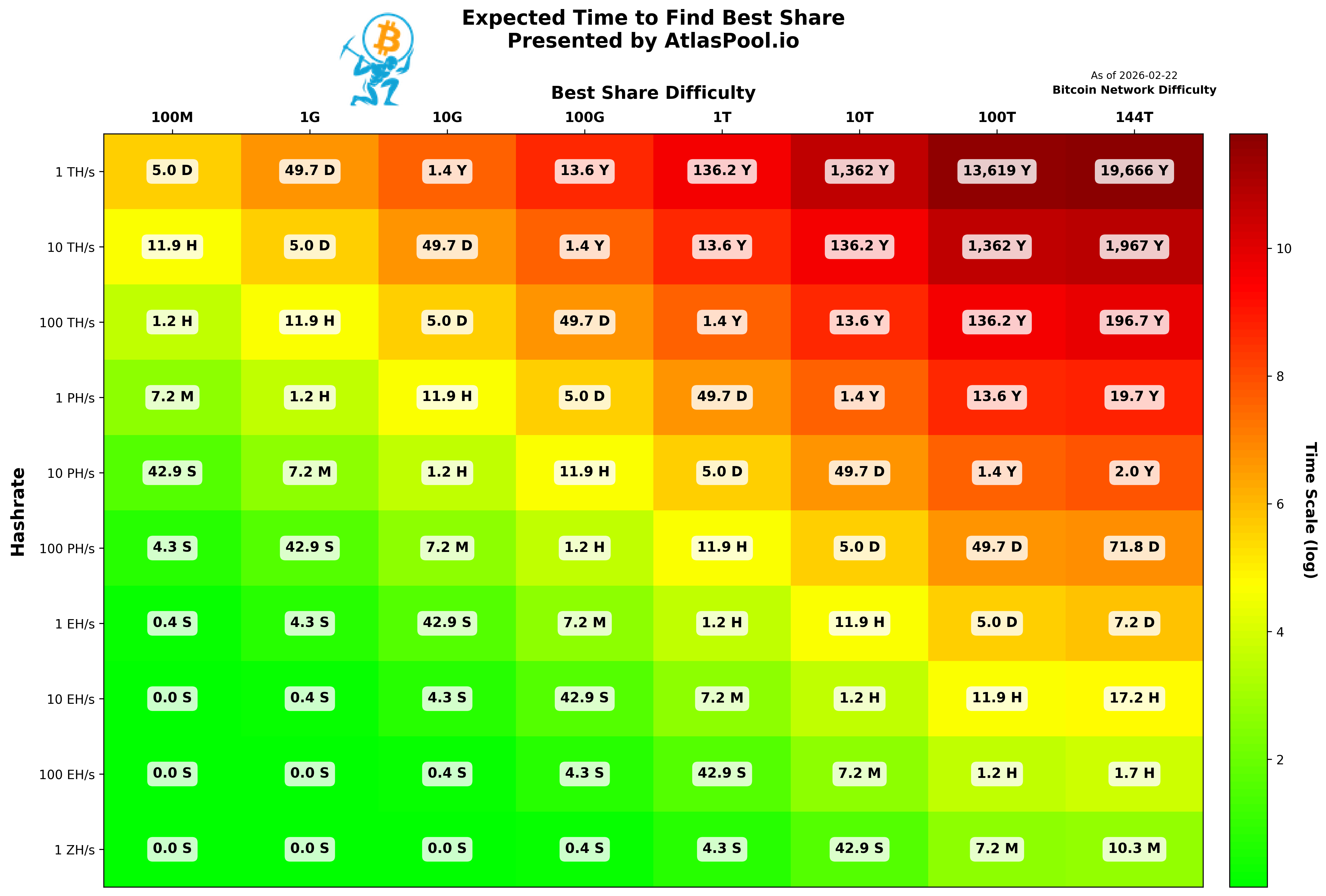
This color-coded matrix shows the expected time to find a block based on your hashrate (vertical axis) and the target difficulty (horizontal axis). Here's how to read it:
- Green zones: Fast—seconds to minutes
- Yellow zones: Moderate—hours to days
- Red zones: Slow—years to millennia
The rightmost column shows 144.40T—the current Bitcoin network difficulty. This is what you need to beat to find a block.
Explore AtlasPool's Solo Mining Calculators
Want to dive deeper into the math? Our interactive calculators let you explore probability, expected time, and mining scenarios with your own hashrate.
Try the CalculatorsReal-World Examples
Let's look at three scenarios using our formula at the current difficulty of 144.40T:
- Bitaxe Gamma (1.2 TH/s): ~16,400 years
- Avalon Q (90 TH/s): ~219 years
- AtlasPool's Hashrate on 2026-02-21 (2.60 PH/s): ~7.6 years
Yes, even an entire pool with over 2.6 petahash would take over 7 years on average. But here's the thing about probability: someone has to win, and it could be you.
Expected Time vs. Reality: Understanding Probability
Here's the most important thing to understand: "expected time" is an average, not a guarantee.
When we say a Bitaxe Gamma would take 16,400 years on average to find a block, that doesn't mean you need to wait 16,400 years. It means:
- You could find a block on your first day of mining (it's happened!)
- You could find a block after 1 year of mining
- You could mine for 50 years and never find one
- Or you could find two blocks in the same week (extremely rare, but possible!)
The Lottery Analogy
Think of it like buying lottery tickets. If the odds are 1 in 10 million, that doesn't mean you need to buy 10 million tickets to win. You could win on your first ticket, or you could buy 20 million tickets and never win.
The difference with Bitcoin mining? You're buying billions of "lottery tickets" per second. Every hash is a new chance to win.
This follows what statisticians call a Poisson distribution. In simple terms: random events that happen independently over time. Your chance of finding a block in the next second is exactly the same as your chance in any other second—it doesn't matter how long you've been mining.
Understanding Your Odds
The numbers might seem impossibly small, but here's the reality: with a Bitaxe Gamma at 1.2 TH/s, you're computing 1.2 trillion hashes per second—that's over 103 quadrillion attempts per day. Your daily chance of finding a block is about 1 in 6.1 million days. With an Avalon Q at 90 TH/s, those odds improve dramatically to about 1 in 82,000 days.
To put this in perspective, finding a Bitcoin block with a Bitaxe in one day is about 20 times more likely than flipping a coin and getting heads 28 times in a row. The key difference? You get to play the Bitcoin lottery billions of times per second, and every single hash is an independent chance to win.
Why Solo Mine?
Despite the astronomical odds, solo mining offers unique rewards that go beyond just the financial jackpot. When you find a block, you keep the entire reward—currently 3.125 BTC plus transaction fees (approximately $212,500 USD as of February 2026), minus any pool fees if applicable. But the appeal goes deeper than the money.
There's an undeniable thrill to solo mining. Every hash your miner computes could be THE hash that finds a block. It's the ultimate lottery where you get billions of tickets per second, and the anticipation never fades. Many solo miners describe it as addictive—constantly checking their dashboard, watching their best share climb, dreaming of that life-changing notification.
Solo mining also supports Bitcoin's core principle of decentralization. By running your own mining operation—whether it's a single Bitaxe or a farm of ASICs—you're contributing to the network's security and independence. You're not just another worker in a massive pool; you're a sovereign participant in the Bitcoin network.
Solo mining makes sense if:
- You understand it's a lottery, not steady income
- You can afford the electricity costs
- You enjoy the thrill of the chase
- You want to support Bitcoin's decentralization
- You'd be mining anyway as a hobby
Consider pool mining if: You need predictable income or have significant hashrate with access to relatively cheap power and want consistent returns.
Why Solo Mine Through AtlasPool?
AtlasPool provides enterprise-grade solo mining infrastructure designed for maximum uptime, a fast and globally deployed network, and well-connected Bitcoin nodes. For more details about AtlasPool's features and benefits, visit our Why AtlasPool page.
Global Low-Latency Infrastructure
Our stratum service is announced out of 100+ Edge locations worldwide, with connections terminating at the closest of seven endpoints:
- North America: Ashburn, VA (US) and Portland, OR (US)
- South America: São Paulo (BR)
- Europe: Frankfurt (DE) and London (UK)
- Asia: Hong Kong (HK) and Mumbai (IN)
- Australia: Sydney (AU)
This global anycast network ensures your miner connects to the nearest stratum endpoint with minimal latency. When you find a block, every millisecond counts—you're racing against other miners who might have found the same block. AtlasPool's Bitcoin nodes are specially tuned to be very well connected to the Bitcoin network for ultra-fast block propagation. Low latency also reduces the odds of rejected shares, which is critical because rejected shares represent wasted work—miners should minimize rejected shares as much as reasonably possible.
The Bottom Line
Solo mining is a numbers game, but understanding those numbers gives you power. You now know:
- What difficulty actually means (target hash value, leading zeros)
- How miners compare each hash to network difficulty
- What a best share is and why it's fun to track
- The exact formula for calculating expected time
- That "expected time" is an average—you could win tomorrow
- Your actual odds with different hashrates
- How to read the infographic (your new favorite mining reference)
- Why infrastructure matters when you find that block
But someone's going to find the next block. Why not you?
Point your miners at AtlasPool's solo port, defy the odds, and maybe—just maybe—you'll be the one posting that screenshot of a solved block. We'll be here, routing your solution across our global network with minimal latency, ready for when lightning strikes.
Happy hashing! ⚡
Ready to Start Solo Mining?
Standard solo mining (recommended for most miners):
Port: stratum+tcp://solo.atlaspool.io:3333
Starting difficulty: 2,000 (adjusts automatically based on your hashrate)
High-difficulty solo mining (for mining rentals):
Port: stratum+tcp://solo.atlaspool.io:4334
Starting difficulty: 1M (1 million)
Acknowledgements
Thank you to Philip D'Ath and Travetown for their review and feedback on this article.
Questions, corrections, or feedback? Reach out to @AtlasPool_io on X, or join us on Discord.